
- April 24, 2026|
- Doors|
- sandymount_admin
Energy efficient doors are specially designed exterior doors built to minimise heat transfer and air leakage between the inside and outside of your home. Unlike older, standard doors, they combine advanced materials, quality glazing, compression seals and thermal-rated frames to hold warmth inside during winter and keep excess heat out during summer. The result is a more comfortable home and noticeably lower energy bills.
If you just need the short answer: a door is energy efficient when it achieves a U-value of 1.4 W/m²K or below (the current UK requirement for replacement doors under Part L Building Regulations), uses multi-chambered or thermally broken frames, and is fitted with weather-tight perimeter seals that eliminate draughts.
Read on for a complete breakdown of exactly how each component works, which materials perform best, and what ratings you should look for before you buy.
What makes a door energy efficient?
Several interconnected features determine how well a door retains heat. Miss one and the others work less effectively.
The door material
The material of the door leaf itself is the single biggest variable in thermal performance. Here is how the most common options compare:
| Material | Thermal performance | Key characteristic |
| Composite (GRP + foam core) | Excellent | Thick insulated core; very low U-values achievable |
| uPVC | Very good | Multi-chambered profile; lightweight and affordable |
| Thermally broken aluminium | Good to excellent | Slim sightlines; polyamide break prevents conduction |
| Solid wood (uninsulated) | Poor to moderate | Natural but prone to warping and heat loss |
Composite doors are among the strongest all-round performers. Their construction combines a highly insulated foam core with an impact-resistant GRP (glass-reinforced plastic) skin, giving the look of timber without the thermal drawbacks. At Sandymount, our composite doors are crafted with precisely this construction, delivering excellent heat retention alongside exceptional security.
Thermally broken aluminium is the material of choice for large-span doors such as bi-folds and sliding doors. A polyamide thermal break sits between the inner and outer sections of the aluminium frame, interrupting the conductive path that would otherwise allow heat to escape through the metal.
uPVC uses multi-chambered frame profiles to trap still air and resist heat flow. It is one of the most cost-effective ways to achieve strong thermal performance and already meets current UK building regulation standards.
The glazing unit
Where a door includes glass, the specification of that glazing unit has an enormous impact on overall performance.
Double glazing uses two panes of glass separated by a gap filled with argon or krypton gas. The gas is a poor conductor of heat, so it slows the rate at which warmth escapes through the pane.
Triple glazing adds a third pane and a second gas-filled cavity. It is particularly effective in colder climates or for rooms where comfort is critical.
Low-emissivity (Low-E) coatings are applied to the inner surface of the glazing unit. They work by reflecting long-wave radiant heat back into the room rather than allowing it to pass through the glass. This is one of the most effective single upgrades within a glazing unit.
For glazed doors that are more than 60% glass, UK Building Regulations set a target U-value of 1.2 W/m²K. Choosing double or triple glazing with a Low-E coating and warm-edge spacer bars is the reliable route to meeting and exceeding that target.
Seals, weatherstripping and thresholds
Even a thermally excellent door leaf will underperform if the seals around its perimeter allow air to bypass the frame. Draught-proofing is not cosmetic – it is structural. Cold air infiltration and warm air exfiltration both increase the energy your boiler works to replace.
Look for:
- Compression seals that are compressed when the door closes rather than just brushing past
- Multi-point locking systems that pull the door tight against seals at several points around the frame
- Low threshold or door shoe profiles that seal the gap at the bottom of the door without creating a trip hazard
- Continuous perimeter gaskets in bi-fold and sliding doors that maintain a weathertight barrier even across wide openings
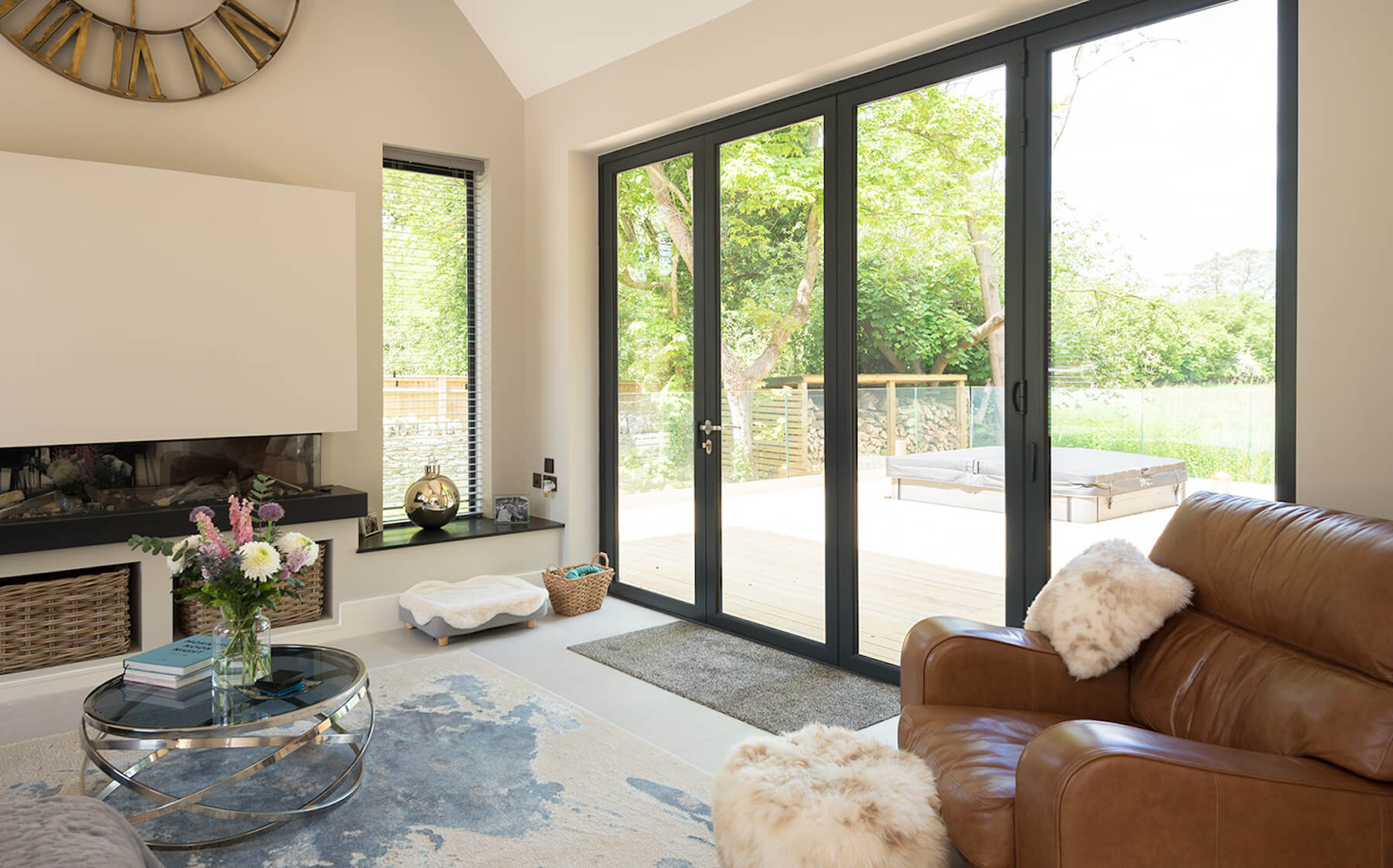
Our bifold doors from Origin feature thermal break technology and weathertight seals specifically designed to prevent heat loss and maintain performance year-round.
The frame and thermal bridging
Metal frames conduct heat far more readily than the door leaf itself. Without intervention, a metal frame can account for a disproportionate share of total heat loss. Thermal bridging occurs wherever a conductive material creates a direct path between the warm interior and cold exterior, bypassing the insulation.
Modern thermally broken aluminium frames address this by inserting a polyamide strip (a type of engineered plastic) through the centre of the frame profile. This interrupts the conductive path and allows aluminium doors to achieve U-values that would otherwise be impossible in metal.
Our aluminium doors from Origin feature a polyamide thermal break that helps prevent heat loss, reduce energy bills, and maintain a comfortable temperature throughout the year.
Understanding door energy ratings and U-values
When comparing doors, three measurements are most relevant to UK homeowners.
U-value (thermal transmittance)
The U-value measures the rate at which heat passes through the complete door assembly, including frame, slab and any glazing. The lower the U-value, the better the door insulates. It is expressed in watts per square metre kelvin (W/m²K).
Under the current Part L Building Regulations (updated June 2022):
- Replacement doors in existing UK homes: maximum U-value of 4 W/m²K
- Doors in new-build dwellings: target U-value of 2 W/m²K (limiting value 1.6 W/m²K)
- Highly glazed doors (over 60% glass): target U-value of 2 W/m²K
High-performance systems can go significantly further. Some premium aluminium bifold systems achieve U-values from 0.8 W/m²K, which meets Passivhaus standards.
The most important thing to understand is this: a door’s quoted U-value is only achieved when it is properly installed with correct frame alignment and airtight sealing. A premium door with a poor installation will underperform a modest door fitted correctly.
R-value (thermal resistance)
R-value is the inverse of U-value – it measures a material’s resistance to heat flow rather than its transmittance. The higher the R-value, the better the insulation. You will encounter this metric more frequently in American product literature, but it is useful context. A basic wood door might achieve R-2; a well-specified composite door with foam core can exceed R-6.
Door Energy Rating (DER)
The Door Energy Rating system uses a scale from G (worst) to A+ (best), similar to the familiar rating labels on appliances. It accounts for solar gain as well as heat loss, giving a net performance figure. For replacement doors in existing homes, the minimum acceptable DER is Band C.
Door material comparison: which is most thermally efficient?
Are composite doors the most energy efficient?
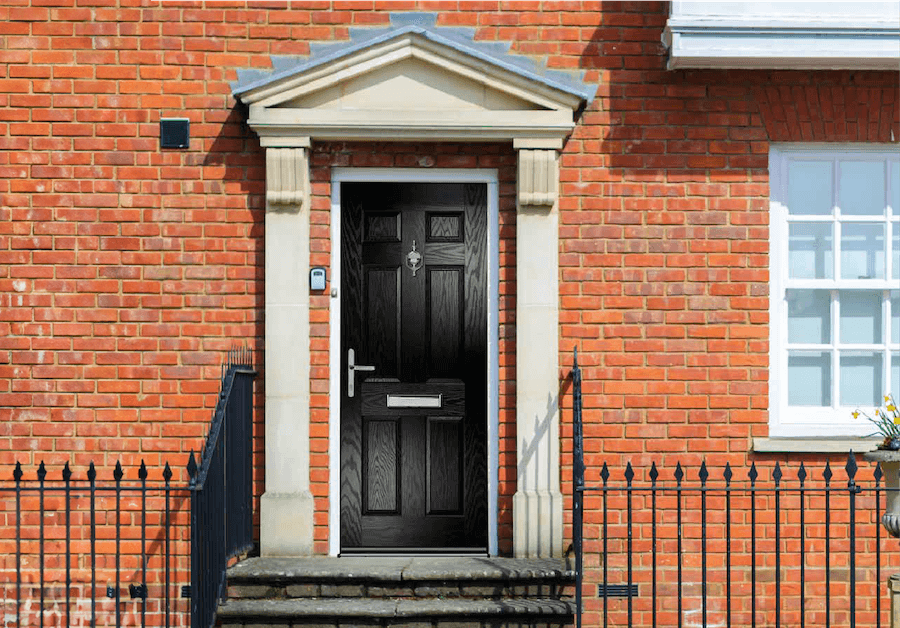
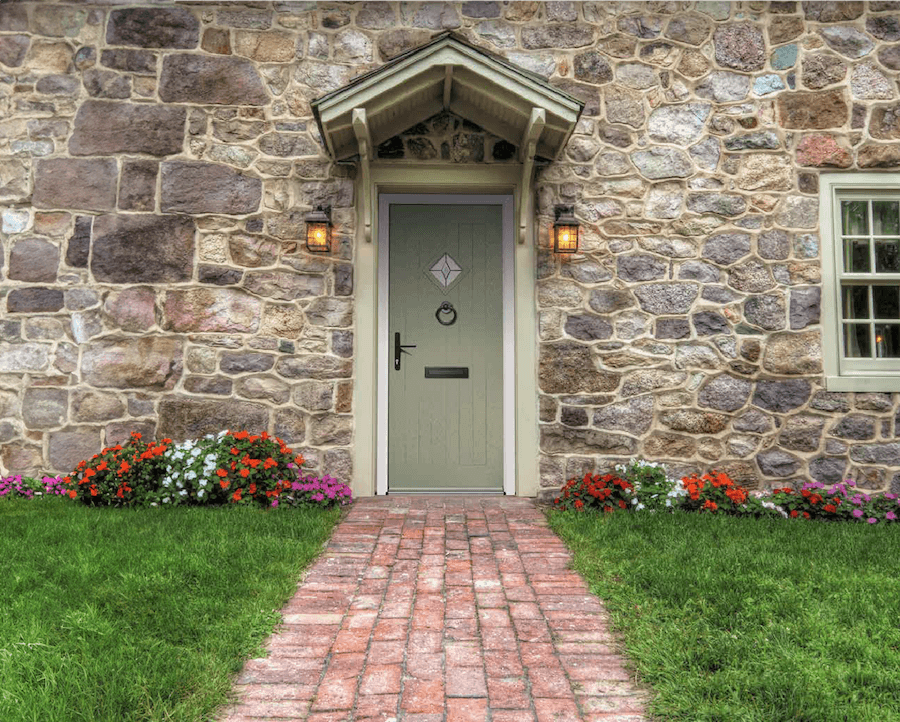
For front and entrance doors, composite construction consistently delivers the strongest thermal performance alongside the most practical benefits. The foam core provides very high resistance to conductive heat loss. The GRP skin does not warp, swell or rot as timber does, meaning the door maintains its seal over decades. Multi-point locking hardware pulls the door firmly against its compression seals at several points, eliminating draughts that single-point locks cannot address.
At Sandymount, our composite doors are supplied from leading manufacturer Hallmark and are fully customisable in a wide range of colours and woodgrain effects, including any RAL colour and dual-colour shades.
Are aluminium doors energy efficient?
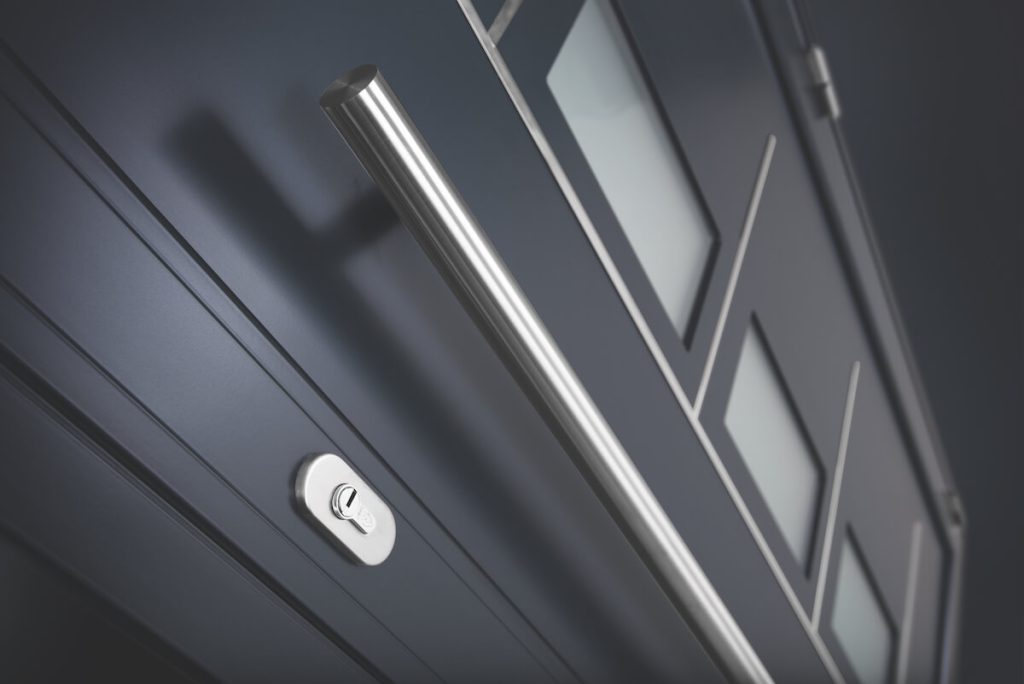
Aluminium is a highly conductive metal, but with a quality polyamide thermal break, aluminium doors are extremely energy efficient and capable of exceeding UK Building Regulation requirements. The thermal break physically separates the inner and outer aluminium sections, preventing the frame from acting as a heat bridge.
The advantage of aluminium over composite for larger openings is structural. Aluminium profiles can span much wider openings with slimmer frames, allowing more glass area while maintaining rigidity. This makes thermally broken aluminium the standard choice for bi-fold doors, sliding doors and large French doors.
Our sliding doors are capable of achieving incredibly low U-values and are designed to prevent heat loss while offering weathertight seals for complete weather protection.
Are uPVC doors energy efficient?
uPVC is a very good insulator. Its multi-chambered profile traps pockets of still air within the frame, slowing heat transfer without the need for a separate thermal break component. uPVC entrance doors are highly energy efficient, already compliant with current UK building standards, and one of the most affordable ways to upgrade an older, draughty door.
How much heat do doors actually lose?
The scale of heat loss through poorly specified or ageing doors surprises many homeowners. Windows and doors together account for approximately 25% of the energy used to heat and cool buildings, with a significant portion wasted through conduction and faulty seals. Doors alone can be responsible for up to 11% of all air leakage in a home despite representing a small share of the total wall area.
An older, single-panel door without modern seals or insulated core loses heat across three mechanisms:
- Conduction through the door leaf and frame material
- Infiltration of cold air through gaps at the perimeter
- Radiation of heat through uncoated single-pane glass (where present)
Modern energy efficient doors address all three. The insulated core slows conduction, the compression seals eliminate infiltration, and Low-E double glazing dramatically reduces radiant loss.
The real-world benefits of upgrading to energy efficient doors
Lower heating bills
This is the most direct benefit. A home that retains heat more effectively needs less energy to maintain its temperature. Replacing a poorly insulated front or back door removes one of the most common points of heat loss in older properties.
Consistent indoor comfort
Cold spots and draughts near doors are not just uncomfortable, they are symptoms of thermal failure. A door that meets current U-value requirements creates a consistent barrier, eliminating the drop in temperature that residents often feel when sitting near older exterior doors in winter.
Reduced condensation
Poorly insulated doors allow the interior surface to cool to the point where warm, humid indoor air condenses on it. This leads to persistent condensation, potential mould growth and damage to frames. A thermally efficient door keeps the interior surface warmer and significantly reduces this risk.
Better acoustic performance
The same mass and sealing properties that reduce heat transfer also attenuate sound. Thicker glazing units, foam-cored door slabs and continuous perimeter seals all contribute to meaningful noise reduction – relevant for homes on busy roads or near urban noise sources.
Higher property value and EPC rating
A door that meets or exceeds current building regulation U-values contributes positively to a home’s Energy Performance Certificate (EPC) rating. A higher EPC rating is increasingly important for property sales and lettings, and energy efficient upgrades are among the most cost-effective ways to improve it.
Environmental impact
Homes that need less energy to heat produce lower carbon emissions. With heating and powering buildings currently making up around 40% of the UK’s total energy use, every improvement to a home’s thermal envelope makes a measurable difference to its environmental footprint.

What to look for when buying an energy efficient door
Use this checklist before committing to any replacement door:
- U-value at or below 1.4 W/m²K for replacements in existing UK homes
- Multi-point locking to compress seals evenly around the full perimeter
- Thermally broken frame for all aluminium doors
- Double or triple glazing with Low-E coating and argon or krypton fill
- Warm-edge spacer bars at the glass edge to reduce cold bridging within the unit
- Compression seals (not brush seals) at the head, jambs and threshold
- FENSA-registered installer to ensure compliance with Part L and issue the required Building Regulations certificate
This last point matters more than many homeowners realise. Professional installation is not optional – it is the difference between a door performing at its rated specification and one that loses 20-40% of that performance through gaps created by poor fitting.
Energy efficient door types at Sandymount Windows & Doors
At Sandymount, every door we supply is designed with thermal performance in mind and meets the current stringent Building Regulations. Here is how our door range aligns with what you now know about energy efficiency:
**Composite doors** – Foam-core insulation with GRP skin. Excellent U-values, superior weather resistance and multi-point locking as standard. Fully bespoke in any RAL colour or woodgrain effect.
**Bifold doors** – Origin aluminium with polyamide thermal break. Available in three configurations (OB-36, OB-49, OB-72). Create expansive indoor-outdoor openings without compromising on thermal performance.
**Sliding doors** – Origin aluminium in four ranges (OS-20, OS-29, OS-44, OS-77) with ultra-slim sightlines, weathertight seals and low U-values. Ideal for maximising glass area while retaining heat.
**French doors** – Available in uPVC and aluminium. Multi-chambered frames and quality glazing help to retain heat and reduce energy bills. PAS24 compliant and Secured by Design accredited.
**Entrance doors** – Thermally efficient front and rear doors in composite, aluminium and uPVC, custom-made to your exact requirements.
All of our installations are covered by our FENSA, BFRC and CHAS accreditations, meaning every door we fit is independently verified for compliance, quality and customer protection.
Frequently asked questions
What U-value should an energy efficient door have in the UK?
For replacement doors in existing UK homes, current Building Regulations require a maximum U-value of 1.4 W/m²K. For new-build dwellings, the target is 1.2 W/m²K. The lower the U-value, the better the thermal performance. Many premium composite and thermally broken aluminium doors significantly exceed these requirements.
What is the most energy efficient type of door?
For entrance doors, composite doors with foam cores consistently achieve the lowest U-values and the best all-round thermal performance. For large glazed openings such as bi-folds and sliding doors, thermally broken aluminium with double or triple Low-E glazing is the standard high-performance choice.
Do energy efficient doors really reduce heating bills?
Yes. Replacing an older, poorly sealed door removes one of the most common routes for heat loss in a home. The extent of the saving depends on how draughty the old door was and how well the new door is specified and installed.
What is a thermal break in a door frame?
A thermal break is a strip of non-conductive material, typically a polyamide (engineering plastic), inserted through the centre of a metal frame profile. It physically separates the inner and outer sections of the frame, preventing the metal from acting as a conductor and allowing heat to bypass the door’s insulation.
Are bi-fold doors energy efficient?
Yes, when specified correctly. Modern aluminium bi-fold doors with polyamide thermal breaks and double or triple Low-E glazing can achieve U-values well within current Building Regulation limits. Our Origin bi-fold doors at Sandymount feature thermal break technology designed specifically to prevent heat loss. You can read more in our dedicated guide to energy efficient bi-fold doors.
What is the difference between U-value and R-value?
U-value measures how quickly heat passes through a door (lower is better). R-value measures resistance to that heat flow (higher is better). They are inverses of each other. In the UK, U-value is the standard metric used in Building Regulations and product specifications.
Do new doors need building regulations approval in the UK?
Yes. Replacing an external door in England requires compliance with Part L of the Building Regulations, which sets the maximum allowable U-value. Work must either be carried out by a FENSA-registered installer (who self-certifies compliance) or submitted to your Local Authority Building Control for approval.
Ready to upgrade?
If you are considering new doors for your home in Gloucestershire, Wiltshire, Oxfordshire or Bristol, our team at Sandymount Windows & Doors can guide you through every option – from materials and glazing specifications to thermal ratings and installation compliance.
Visit our Cirencester showroom to see our full range in person, or contact us today for expert, no-pressure advice on the right energy efficient doors for your property.